
Introduction
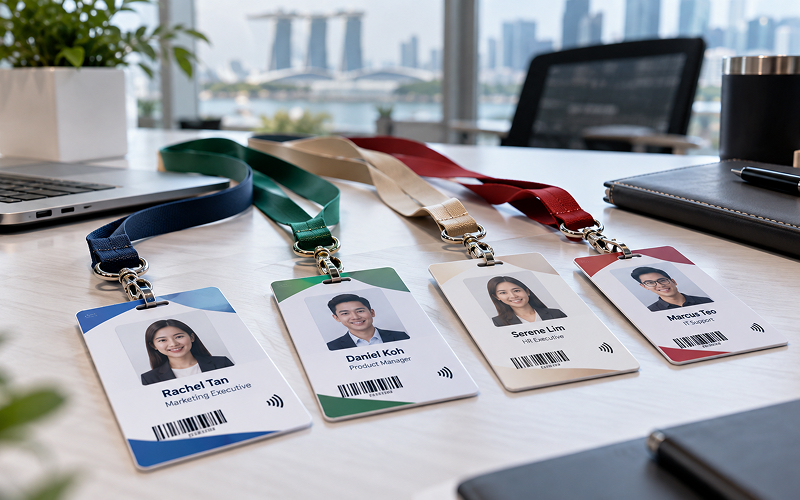
Customised ID cards and lanyards do more than identify who works for your company. In offices, client-facing environments, and business events, they help establish a consistent staff presence, make employees easier to recognise, and reinforce how the company is represented.
Their value is also operational. A well-planned ID system can support access control, clarify roles and reduce small points of friction that slow teams down. For larger organisations, especially those with multiple departments or frequent visitors, clear identification can also make it easier for people to navigate the workplace, find the right contact, and understand who has access to particular areas.
Below, we look at how our customised ID cards and lanyards can strengthen brand identity while also contributing to employee productivity and smoother workplace routines.
Key Takeaways
- Customised ID cards and lanyards can strengthen brand identity by giving employees a consistent, recognisable appearance across offices, meetings, and events.
- Branded accessories can also increase visibility beyond the workplace, particularly in busy business districts, trade shows, and other shared professional spaces.
- Clear identification, RFID access, and simple role differentiation can reduce everyday friction and support employee productivity.
- Effective design should balance branding with usability: names, photographs, roles, colours, and access features all need to remain clear and practical.
- The best ID system is one that fits how employees actually work, from the card technology and colour coding to whether a lanyard, holder, or badge reel is most suitable.
How Customised ID Cards and Lanyards Strengthen Brand Identity

Brand identity is the combination of visual elements, tone, and presentation that helps people recognise and remember a company. It includes obvious touchpoints such as logos, colours, and signage, but also smaller details that employees and customers encounter every day.
1. Create a Consistent Staff Appearance
Employees do not need identical uniforms for a business to look coordinated. ID cards and custom-made lanyards can create that consistency by carrying the same colours, logo, and typography across the team.
For example, employees from sales, operations, and HR may dress differently for their roles, but matching lanyards and ID cards make it immediately clear that they represent the same company. This is especially useful at client meetings, recruitment fairs, conferences, and trade shows, where several organisations may be represented in the same space.
The design should still prioritise identification. Names, photographs, and job roles need to be easy to read, while logos and brand colours should support rather than compete with that information. A simple, consistent layout usually creates a stronger professional team look than trying to place your brand’s visual identity on every available part of the card.
2. Make Your Brand More Recognisable
Branded ID accessories can also increase visibility outside the workplace because employees naturally wear them as they move between the office, meetings, events, lunch spots, and nearby transport hubs.
Consider a company based in a busy Singapore business district. If its office is a stone’s throw from larger names such as Google, BYD, or TikTok, employees will regularly cross paths with people from other companies in the same area. Seeing the same company name, colours, and logo on staff lanyards over time can help build brand recognition among people who work, meet, or spend time nearby.
The same principle applies at industry events. A custom lanyard can make employees easier for clients, partners, and prospects to spot across a crowded exhibition hall. It may also appear in group photographs, event videos, and social media posts, giving your brand visibility beyond the event itself.
3. Coordinate Employee Identification with Other Brand Touchpoints
Customised branded lanyards are most effective when they feel like part of the same visual system as the rest of your event materials. At a trade show, recruitment fair, or client event, staff identification should sit naturally alongside booth signage, presentation decks, printed collateral, and digital displays.
For example, a business attending an exhibition could use the same core colours, logo treatment, and typography across its booth graphics, staff ID cards, and lanyards. The items do not need to look identical, but they should clearly belong to the same brand strategy, even outside the office.
How Brand-Aligned Accessories Support Workplace Organisation
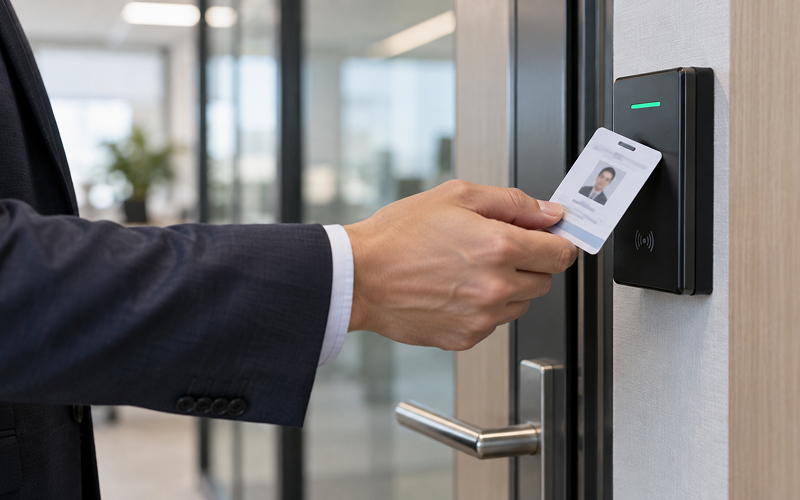
ID cards and lanyards can support more than a consistent brand identity. When they are designed around how people actually use the workplace, they can make access, identification, and everyday coordination more straightforward.
These small improvements can reduce unnecessary steps and support employee productivity, particularly in larger offices with multiple teams, access zones, and frequent visitors.
1. Streamline Access and Routine Processes
In workplaces with compatible Radio-Frequency Identification (RFID) systems, an employee ID card can provide access to doors, lifts, meeting rooms, or restricted areas without requiring separate keys or repeated manual checks.
The same card may also support functions such as attendance, check-ins, or access verification, depending on the systems in place. This can reduce reliance on paper registers, multiple credentials, or administrative staff manually confirming access.
For example, an employee who regularly moves between office floors should not need to borrow a key or wait for someone else to open a secured area each time. Removing these repeated delays can make everyday routines more efficient and support employee productivity.
2. Make People and Roles Easier to Identify
Well-designed ID cards help employees, clients, and visitors quickly see who someone is and what they do. This is especially useful in larger organisations, where hybrid schedules, new hires, and cross-functional teams mean not everyone will recognise one another.
Displaying a name, photograph, department, or job function can make it easier to find the right person. For example, someone visiting another department may be able to identify a member of HR, IT, or facilities without asking several people first.
You can also use simple colour coding to distinguish departments or functions where needed. However, the system should remain easy to understand, as too many colours and categories can lead to further confusion.
3. Distinguish Employees, Visitors, and Contractors
Not everyone moving through an office has the same role or access permissions. Using clearly differentiated ID cards, lanyards, or passes can help staff recognise employees, contractors, visitors, and event participants at a glance.
For example, permanent employees might use the standard company lanyard, while visitors receive a clearly different pass that is valid only for the duration of their visit. Contractors working on-site could have another identifiable design where operational or security requirements call for it.
This makes visitor management easier for reception and security teams while also helping employees understand when someone may need directions or assistance. In larger offices, where unfamiliar faces are common, these visual distinctions can improve workplace organisation without requiring staff to stop and verify every person manually.
Balancing Brand Identity with Practical ID Card and Lanyard Design
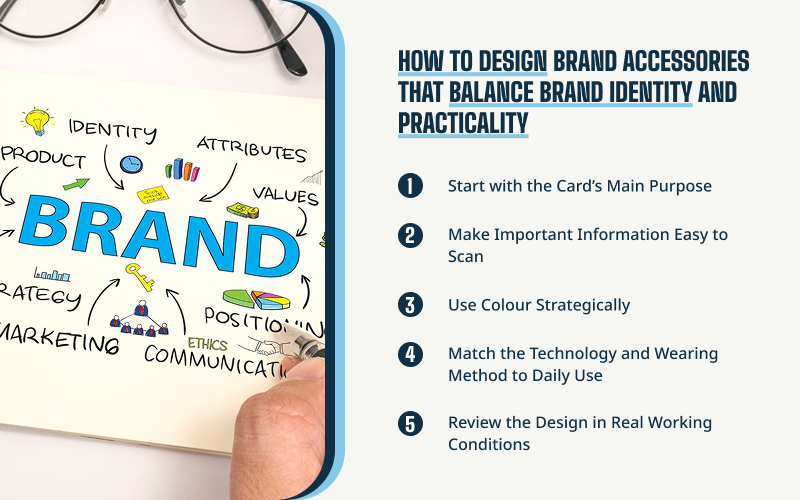
A well-designed ID card and lanyard system should do two things at once: make the company easier to recognise and make everyday workplace interactions more efficient. The following design decisions help balance both brand identity and practicality.
1. Start with the Card’s Main Purpose
Decide on the practical requirements before working on the visual design. Depending on the workplace, the card may be used for identification, door access, attendance tracking, department recognition, or visitor management.
These needs should guide the card type and layout. For example, an RFID access card still needs enough space for a clear name, photograph, and company branding, while a visitor pass may prioritise status and expiry information.
Defining the purpose first helps avoid unnecessary features and creates a simpler system that supports both brand identity and workplace organisation.
2. Make Important Information Easy to Scan
Names, photographs, job titles, and departments should be easy to find within a few seconds. At the same time, the layout should reflect the company’s brand identity through consistent colours, fonts, and logo placement.
A clear hierarchy works best:
- Give the employee’s name and photograph the strongest emphasis
- Keep job titles and departments easy to locate
- Place secondary details lower in the layout
- Avoid decorative elements that compete with essential information
This makes the card look consistent with the brand while helping colleagues, clients, and visitors identify the right person more quickly.
3. Use Colour Strategically
When choosing colours, start with the company’s core brand palette, then decide whether a secondary colour system would make identification easier. For example, you could keep the main card design consistent while using coloured bands, borders, or lanyards to distinguish employees, visitors, contractors, or selected departments.
When planning the colour system:
- Limit the number of categories so they are easy to remember
- Use colours with enough contrast to remain visible in print
- Avoid assigning similar shades to groups that need to be distinguished quickly
- Document what each colour means so reception, security, and employees use the system consistently
This keeps the design aligned with the brand’s identity while making roles or access groups easier to recognise at a glance, which can support smoother coordination in the workplace.
4. Match the Technology and Wearing Method to Daily Use
Choose the card technology and wearing method based on how employees will actually use them during the day.
For access control, first confirm which card type is compatible with the existing system, such as Mifare, HID I-Class, EM, or T5577. If the card is also used for attendance or check-ins, check that the same credential can support those functions before combining everything into one card.
Then consider how often employees need to present or scan it. For example:
- Occasional access: A standard lanyard and card holder may be sufficient for employees who only tap in at the start and end of the day.
- Frequent scanning: A retractable badge reel may be more practical for staff who access several rooms or secure areas throughout the day.
- Customer-facing roles: Keep the card clearly visible and front-facing so names and roles can be read easily.
- Higher-movement environments: Choose clips, holders, or lanyards that stay secure during regular movement and do not interfere with the employee’s work.
Your company’s visual brand identity can then be applied to the accessory that is most visible, such as the lanyard or badge reel, without making the system less practical. The aim is to make access quicker and identification clearer while maintaining a consistent company appearance.
5. Review the Design in Real Working Conditions
Before approving the final design and contacting a reliable card printing service, test how the card and lanyard look and function when worn.
Check whether:
- The logo remains visible when the lanyard twists
- Names and roles can be read from a normal distance
- The card sits at a practical height
- Colours reproduce clearly in print
- Access features work reliably
- The overall design still matches the company’s brand identity
A card that looks polished on a digital mock-up but is difficult to read, scan, or wear will not support employee productivity. The strongest designs work equally well as branding tools and everyday workplace equipment.
Conclusion: Build Identification into Your Wider Branding Strategy
The most useful question is not whether your ID cards and lanyards look branded, but whether they work well for the people wearing and seeing them.
Before finalising a design, check three things: Is the employee easy to identify? Does the card support the access or workplace functions required? Does the overall look clearly belong to your organisation? If the answer to all three is yes, you are more likely to end up with a system that supports both brand identity and workplace organisation.
With decades of experience and Singapore-based, in-house card manufacturing, Paclin Office can support businesses from design through to customised lanyard and ID card printing services. Whether you need branded PVC ID cards, RFID access cards, lanyards, or badge reels, we can help you create an identification system that reinforces your brand identity, works reliably, and fits the way your organisation operates.
Explore our products and services today.
Frequently Asked Questions
1. How often should you replace employee ID cards?
There is no fixed schedule or frequency for replacing your employee’s ID cards. Instead, it’s best to review their company accessories whenever there is a role or department change, a change in brand identity or company rebrand, an update to access permissions, or visible wear that affects readability. Access-enabled cards may also need replacing when your security system or card technology changes.
2. Can one ID card be used for both identification and door access?
Yes. However, it’s important to ensure that the card technology works with your existing access-control system. For example, an RFID-enabled card can carry printed employee details while also functioning as an access credential. Before production, confirm the required RFID type, encoding format, and reader compatibility so the card can perform both functions reliably.
3. What information should not be printed on an employee ID card?
Avoid displaying information that is not necessary for day-to-day identification. Personal contact details, home addresses, identification numbers, medical information, or other sensitive data are generally better kept in secure internal systems. Keep the visible card focused on essentials such as the employee’s name, photograph, role, department, and any information genuinely required for workplace access or identification.
4. How much branding is too much on an employee ID card?
If the logo, colours, or graphic elements make the employee’s name, photograph, or role harder to read, the branding has gone too far. Treat the ID card as an identification tool first, then use a few recognisable brand elements to make it feel consistent with the company. A simpler design is often more effective than trying to reproduce every element of your wider visual brand identity on a small card.
 Paclin